How to Feel Better in Your Body — Starting With Your Next Workout
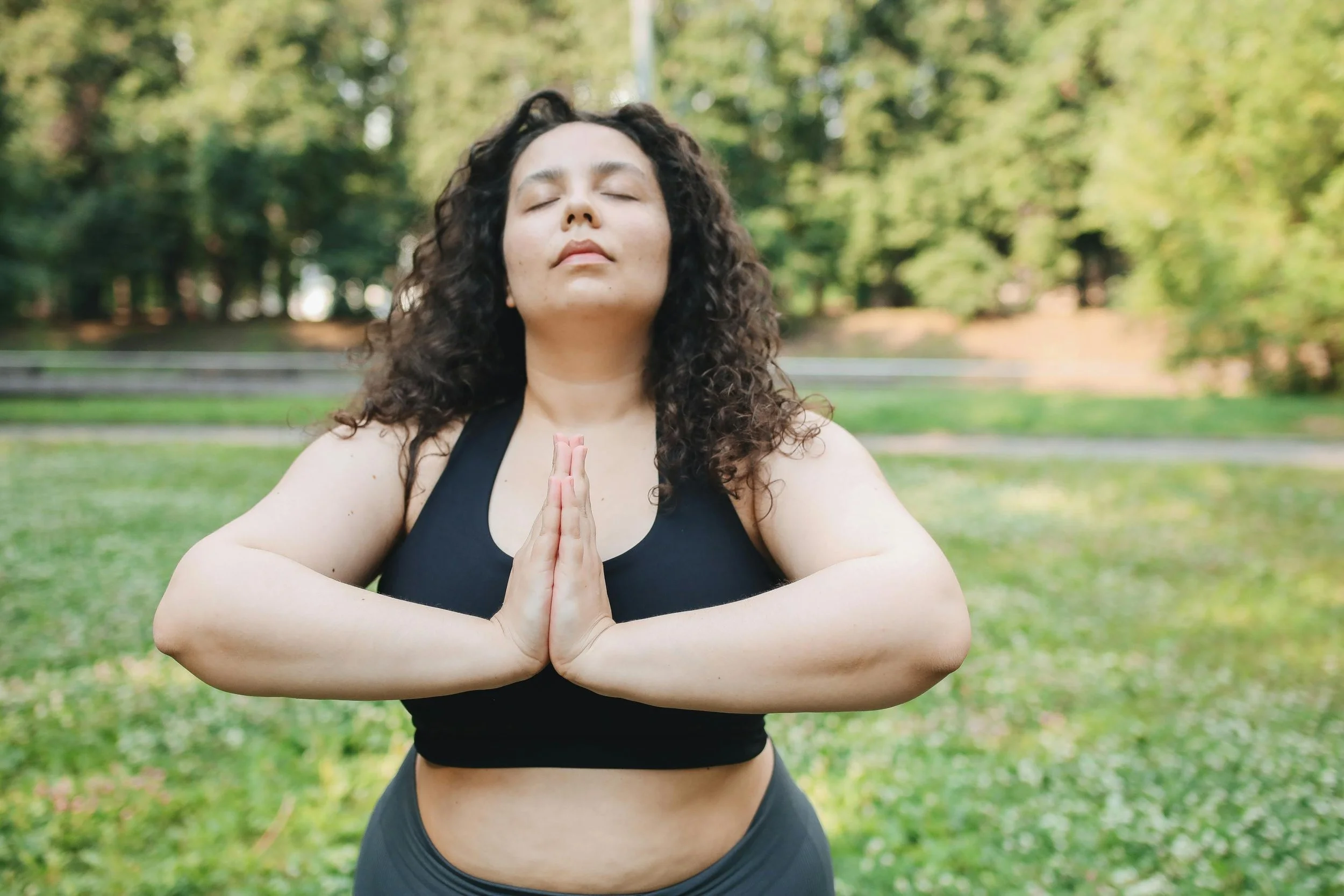
Credit: Polina Tankilevitch
Most exercise advice focuses on what to do - how many reps, how many steps, how many calories. But scientists are finding that how you think while you move matters just as much. And for a lot of people, the thoughts are the hardest part.
Your Body Keeps Score During Exercise
When something feels hard during a workout, the usual options seem obvious: push harder and ignore it, or take it as a sign to stop. But what if there was a third option? It turns out there is - and it starts with paying attention.
Studies show that people who pay attention to what their body feels during exercise - without labelling those feelings as good or bad - develop a more positive relationship with their body over time.1 Scientists call this mindful movement, and its effects go beyond the workout itself.
This is especially true for people who already feel self-conscious about their bodies. For them, a workout can come loaded with uncomfortable feelings - fatigue that feels like failure, discomfort that feels like proof that they don’t belong. Practicing nonjudgmental awareness of those sensations, rather than fighting them, turns out to be one of the most effective ways to keep showing up. 1, 2
When Shame Loses Its Power
One of the trickier parts of exercise culture is how much shame is quietly wrapped up in it. Shame — the sense that your body reveals something fundamentally wrong about you — is different from just feeling bad after a tough session. It's tied to how we think others see us, and whether we measure up to ideals we've absorbed from the world around us.3
Here's what's interesting: research suggests that simply putting words to body shame starts to loosen its hold.4 When you name the feeling — "I feel embarrassed about how I look right now" — something shifts. You're no longer just experiencing the shame; you're also noticing that, on some level, you're holding yourself to a specific ideal. And that noticing creates a little distance. It opens up a question: whose standard is this, anyway?
That small moment of reflection is more powerful than it sounds. It doesn't make the shame disappear, but it moves you from being inside the feeling to being able to look at it — which is exactly the kind of awareness that leads to change.4
The Mindfulness Habit that Transforms Your Workout
There's a version of exercise that happens entirely in your head. While your body moves, your mind tends to wander — back to past attempts that didn't go well, forward to goals that feel out of reach, sideways into comparisons that don't serve you. Most of us are so used to this that we don't even notice it's happening.
But noticing is exactly the point. When you practice bringing your attention back to what's actually happening — this step, this breath, this moment — something gradually shifts.5 The commentary doesn't disappear, but it loses its grip. Your choices start coming from a quieter, steadier place.
Progress You Can’t Measure
Building a better relationship with your body doesn't require a perfect workout or a perfect mindset. It's a practice, and like any practice, it's easy to underestimate how much it's working.
The next time you work out, try this: instead of evaluating how you're doing, just observe how you're feeling. Whatever comes up — let it be there. Not every shift shows up in a mirror or on a scale. Some of the most important ones happen quietly, from the inside out.
Samantha Patterson, CHES®, is a certified Health Education Specialist and summa cum laude graduate from Arizona State University’s College of Health Solutions. She shares approachable, evidence-based guidance for building sustainable health habits that are realistic, flexible, and supportive of everyday life.
1 Jankauskiene, R., & Baceviciene, M. (2024). Mindful monitoring and accepting the body in physical activity mediates the associations between physical activity and positive body image in a sample of young physically active adults. Frontiers in Sports and Active Living, 6, 1360145. https://doi.org/10.3389/fspor.2024.1360145
2 Piran, N. (2019). Body Image Flexibility. In T. Tylka (Ed.), Handbook of Positive Body Image and Embodiment: Constructs, Protective Factors, and Interventions (pp. 42–51).
3 Smith, S. S., Hoor, G. a. T., Lakhote, N., & Massar, K. (2024). Emotion in motion: weight bias internalization, exercise avoidance, and Fitness-Related Self-Conscious emotions. Healthcare, 12(10), 955. https://doi.org/10.3390/healthcare12100955
4 Stage, C., & Nielsen, S. B. (2023). Reversal, Normalization and Self-care: three logics of countering body shame through fitness activities among young Danes. Scandinavian Sport Studies Forum, 14, 2000–088x. https://pure.au.dk/portal/en/publications/ec894d48-bd08-4ffe-8ef3-06093b899055
5 Zhang, C., Leeming, E., Smith, P., Chung, P., Hagger, M. S., & Hayes, S. C. (2018). Acceptance and Commitment Therapy for Health Behavior Change: A Contextually-Driven Approach. Frontiers in Psychology, 8, 2350. https://doi.org/10.3389/fpsyg.2017.02350
